
Two weeks ago, businesses across the country were celebrating Customer Service Week. There were social media posts. There were

Uncategorized
 By Admin
October 19, 2026
Customer Service Shouldn’t Be a Week
By Admin
October 19, 2026
Two weeks ago, businesses across the country were celebrating Customer Service Week.
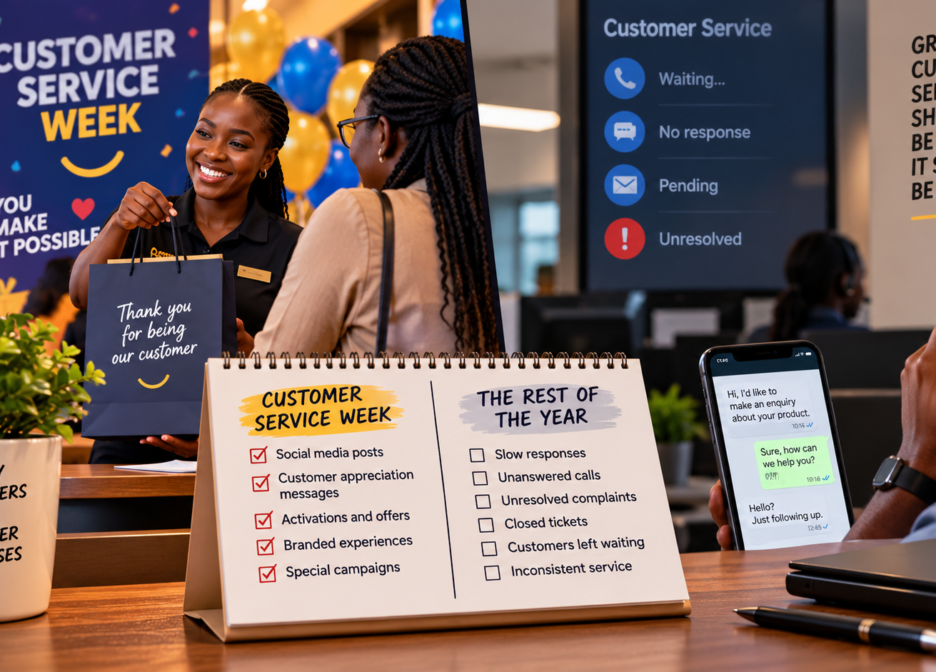
There were social media posts.
There were messages to customers.
There were activations, offers, appreciation events and branded experiences.
And, of course, there were plenty of messages telling customers how important they are.
There is nothing wrong with celebrating customers. In fact, I think businesses should appreciate their customers.
But I couldn’t help wondering:
What happens when Customer Service Week is over?
Because if customers are genuinely at the centre of your business, the experience they receive during one week should not be dramatically different from what they receive during the other 51 weeks of the year.
Customer service is not an event
One of the things we sometimes get wrong about customer service is treating it as an activity.
We organise an activation.
We send a message.
We give customers a gift.
We post a thank-you graphic.
Then the week ends and everyone goes back to business as usual.
But customer service isn’t an event.
It is the experience of doing business with you.
It is what happens when a customer calls your office.
It is how quickly you respond to a WhatsApp message.
It is whether someone takes ownership when there is a problem.
It is whether you keep a customer informed when something is delayed.
It is whether the person serving the customer is helpful or dismissive.
It is what happens after you have received the customer’s money.
That is where customer service really lives.
The contrast shouldn’t be so obvious
In some businesses, Customer Service Week creates an interesting contrast.
For one week, customers are celebrated.
Everyone is reminded to appreciate them.
There are messages about putting customers first.
But outside that week, the same customer may struggle to get a response, spend days waiting for an issue to be resolved, or be passed from one person to another because nobody wants to take responsibility.
That creates a problem.
Because customers don’t experience your campaign.
They experience your business.
And customers are very good at noticing the difference between what a brand says and what a brand actually does.
Put the customer at the centre of the process
If a business genuinely wants to improve customer service, perhaps the better question isn’t:
What are we doing for Customer Service Week?
It should be:
What are we changing about the way we serve customers every day?
That could mean making it easier to reach the right person.
It could mean giving employees the authority to resolve simple problems without seeking five approvals.
It could mean calling a customer back when you promised to.
It could mean checking whether a complaint was actually resolved rather than simply closing the ticket.
It could mean asking customers why they stopped buying from you.
It could even mean reviewing the customer journey from beginning to end and identifying where customers experience unnecessary frustration.
These things may not make for great social media content.
But they make for better businesses.
Appreciation is more than a message
A customer doesn’t necessarily need a branded gift to feel valued.
Sometimes they just want the business to make their life easier.
They want someone to listen.
They want their time respected.
They want accurate information.
They want problems solved.
They want to know that when something goes wrong, someone will take responsibility.
And they want consistency.
Because there is something powerful about dealing with a business and knowing what to expect every single time.
Consistency is one of the greatest forms of customer appreciation.
What if every day was Customer Service Day?
Imagine if businesses treated every day as an opportunity to answer that question:
How can we make this customer’s experience better?
Not through expensive activations.
Not necessarily through discounts.
But through the small things.
Answering the phone.
Responding to the message.
Keeping the promise.
Following up.
Remembering the customer.
Fixing the mistake.
Saying sorry when necessary.
And making it easy for the customer to do business with you.
These are not Customer Service Week activities.
They are business fundamentals.
The real celebration is what happens afterwards
There is nothing wrong with celebrating Customer Service Week.
But perhaps the best measure of whether a business really values its customers is what happens on the Monday after the celebration ends.
Are the phones still answered?
Are the messages still being responded to?
Are complaints still being followed up?
Are employees still empowered to help?
Are customers still being listened to?
Are businesses still looking for ways to make the customer experience better?
Because ultimately, customers don’t need to be celebrated for one week.
They need to be valued every time they choose to do business with you.
So perhaps next year, instead of asking what we will do for Customer Service Week, businesses should ask a more uncomfortable question:
If Customer Service Week disappeared from the calendar, would our customers notice any difference in how we treat them?
If the answer is no, you’re probably doing something right.
If the answer is yes, perhaps Customer Service Week is telling you something.
Don’t make customers feel important for a week. Build a business where they actually are.