
The more precisely you understand your audience, the better you can communicate, build relationships and deliver value. Recently,

Uncategorized
 By Admin
November 23, 2026
One Message Cannot Serve Everyone
By Admin
November 23, 2026
The more precisely you understand your audience, the better you can communicate, build relationships and deliver value.
Recently, I attended a men’s meeting where we were invited to reflect on how the year had been. One man shared his experience of dealing with health challenges and losing someone close to him. Another spoke about the difficulties of navigating life after the end of a marriage. As the conversation continued, several other men opened up about similar experiences, some recent and others from years before.
It was a powerful reminder that people can be in very different places in life, even when they share the same room.
There were men who had recently married, others who had been married for years, and some who were single and hoped to get married one day.
The discussion was valuable for those who needed to share their experiences and find support. But it also got me thinking about how the same conversation might be received differently by people at different stages of life.
A discussion that helps someone process a difficult experience may leave someone else with unanswered questions or a different perception of what lies ahead.
It wasn’t necessarily a problem with the conversation itself. Perhaps the bigger question was whether one setting could adequately serve everyone in the room.
And that got me thinking about business.
The problem with one-size-fits-all
Businesses often talk about knowing their customers, but how often do they genuinely account for the differences within their target market?
We group people together because they share a broad characteristic. They may be the same age, live in the same area, work in the same industry or have similar purchasing power.
But shared characteristics do not automatically mean shared needs.
Consider a bank communicating with university students, young professionals, established business owners and retirees. All may need financial services, but their priorities, concerns and expectations are likely to differ.
A message about building a credit history may resonate with a young professional. A business owner may be more interested in working capital, while a retiree may prioritise security and reliable income.
The bank may be selling financial services to all three groups, but the reason each group buys is not necessarily the same.
When businesses communicate as though everyone has identical needs, they risk becoming relevant to nobody in particular.
Different audiences need different conversations
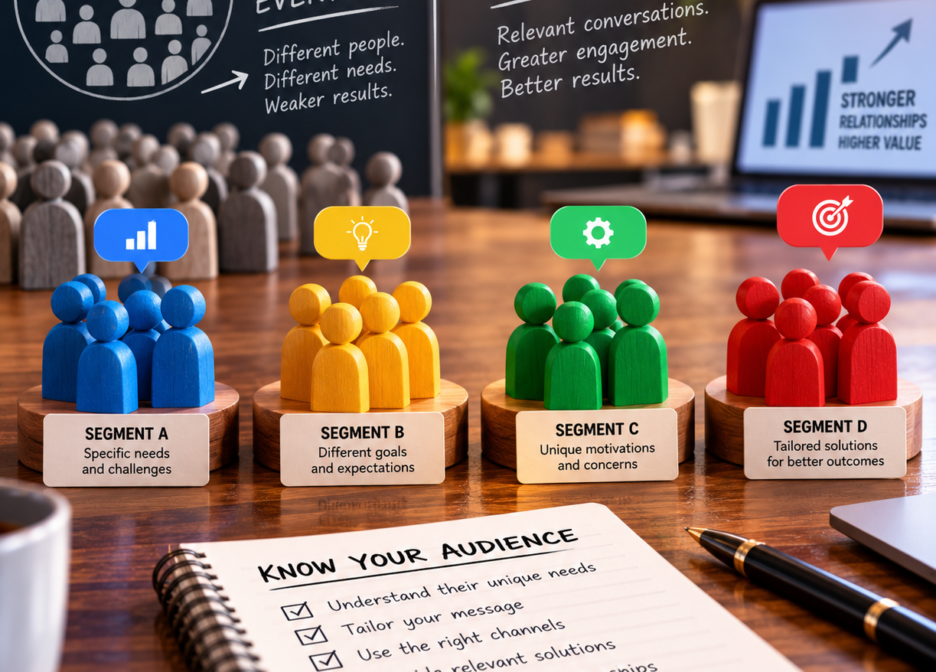
Audience segmentation is not simply about dividing customers into categories for a marketing report.
It is about understanding what matters to each group and adapting your communication, products, services and experiences accordingly.
Think about a property developer targeting first-time homeowners, property investors and families looking for larger homes.
The first-time buyer may need guidance on financing and the buying process. The investor may want information about rental returns and capital appreciation. The family may be more concerned about space, security, schools and access to essential services.
The property may be the same, but the decision-making process is different.
A business that understands these differences can address the questions each customer is actually asking.
One that doesn’t may spend heavily on advertising while leaving potential customers unconvinced.
Effective marketing is not just about reaching people. It is about reaching them with something that matters to them.
Trying to win one audience can alienate another
There is another important consideration.
When businesses focus heavily on one audience, they can unintentionally overlook or discourage another.
A brand that communicates exclusively around luxury may alienate customers who prioritise practicality and affordability. A company that speaks only to experienced users may intimidate beginners who need guidance.
Even a well-intentioned campaign can have unintended consequences if the business fails to consider how different audiences will interpret it.
This does not mean every message must appeal to everyone. In fact, trying to achieve that is often the problem.
Sometimes, the better approach is to create separate messages, experiences or platforms for distinct audiences, while maintaining a consistent overall brand identity.
Start by asking better questions
Businesses don’t necessarily need expensive research to begin understanding their audiences better.
They can start by asking a few simple questions:
- Who are we trying to reach, and what stage of life or business are they in?
- What problem are they trying to solve?
- What concerns or objections might prevent them from taking action?
- What information, support or experience would make our offering more relevant to them?
The answers should influence more than advertising.
They can inform product development, customer service, sales conversations, training, events and even how a business organises its customer support.
The objective is not to create endless categories. It is to identify meaningful differences that affect what people need and how they make decisions.
One brand, different experiences
Of course, segmentation should not mean treating some customers as more valuable human beings than others.
Every customer deserves respect, fairness and professional service.
The difference lies in recognising that equal respect does not always require identical communication or identical solutions.
A new customer may need more explanation than an experienced one. A person facing a complex problem may need a different level of support from someone making a routine enquiry.
Serving both well requires understanding what each needs.
That is the balance businesses should aim for: a consistent brand promise delivered in ways that are relevant to different audiences.
Know who is in the room
The lesson I took from that meeting was not that people with different experiences should never share a conversation. There is real value in bringing people together.
It was a reminder, however, that different people can receive the same message differently, depending on their circumstances and what they need at that moment.
Businesses face the same reality every day.
Before launching a campaign, organising an event or designing a customer experience, it is worth asking whether the people you are bringing together actually need the same conversation.
Because the objective should not simply be to reach the largest possible audience.
It should be to create the greatest possible relevance for the people you want to serve.
You don’t have to speak to everyone in the same way to build one strong brand. You have to understand what matters to each audience.