
One thing I have noticed in business is that customers rarely speak to only one supplier. If someone is looking for a product,

Uncategorized
 By Admin
October 26, 2026
The Lead Is Not the Sale
By Admin
October 26, 2026
One thing I have noticed in business is that customers rarely speak to only one supplier.
If someone is looking for a product, they will probably call two, three or even five businesses.
They may search on Google.
They may ask on WhatsApp.
They may send the same message to several suppliers on social media.
Then they compare.
Price. Quality. Availability. Location. Delivery. Response time. And, increasingly, how easy you are to deal with.
This is where I think many businesses leave money on the table.
The enquiry is only the beginning
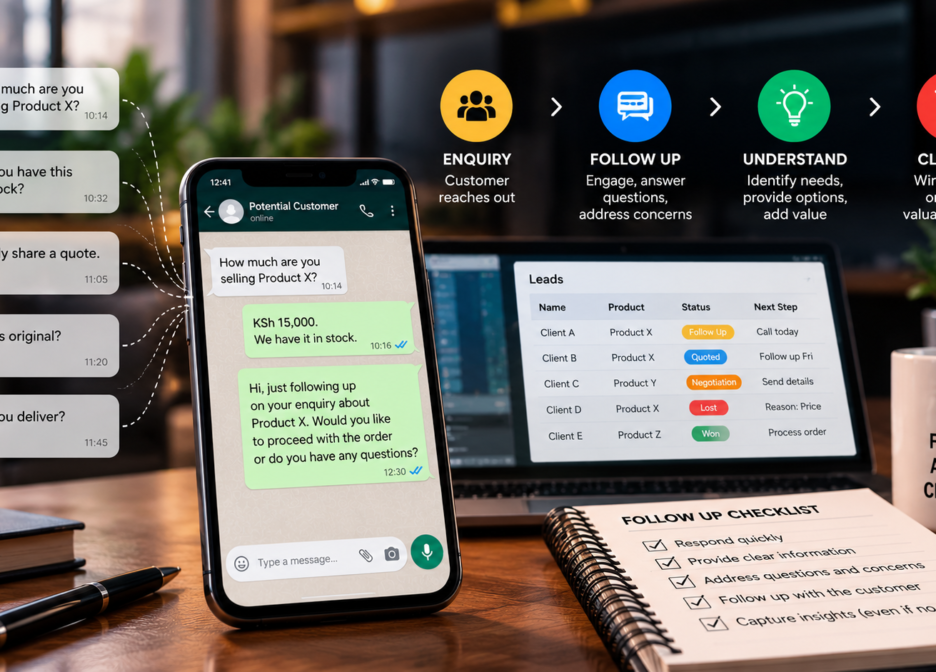
Imagine someone sends you a WhatsApp message:
How much are you selling Product X?
You respond:
KSh 15,000.
And then nothing.
The customer doesn’t respond.
What happens next?
For many businesses, nothing.
The lead is considered dead.
But is it?
The customer may still be comparing prices. They may be discussing the purchase with someone else. They may have concerns about the product. They may not have understood what makes your product different.
Or they may simply have forgotten to respond.
A lack of response is not necessarily a rejection.
Sometimes, it is simply an unfinished conversation.
Follow-up is part of selling
This is why I believe businesses need to take lead follow-up much more seriously.
If someone calls you, emails you, sends you a WhatsApp message or enquires through social media, that interaction should enter your sales process.
Not every lead will become a sale.
But every lead can teach you something.
A simple follow-up can be:
Hi, just following up on your enquiry about Product X. Would you like us to proceed with the order?
The customer can say yes.
They can say no.
Or they can tell you what is holding them back.
And that third answer can be incredibly valuable.
The cheapest price doesn’t always win
Suppose I am looking for a particular product and I contact two suppliers.
Supplier A quotes KSh 10,000.
Supplier B quotes KSh 12,000.
At first glance, Supplier A has won.
But what if Supplier B tells me that the product is original while Supplier A’s product is generic?
What if Supplier B offers a warranty?
What if Supplier B can deliver today?
What if the cheaper product has a different country of origin, specification or expected lifespan?
If nobody explains those differences, the customer will naturally compare the most obvious thing:
Price.
A good salesperson doesn’t simply provide a price.
They help the customer understand what they are buying.
Your leads are also market research
There is another reason to follow up.
Imagine ten people enquire about the same product.
Eight ask whether you can reduce the price.
That is information.
Maybe your price is too high.
Maybe your competitors are cheaper.
Maybe customers don’t understand the value you’re offering.
Or perhaps the product itself is too expensive for the market you are targeting.
You only discover this if you actually engage the people who don’t buy.
A lost sale can therefore give you something almost as valuable as a sale:
insight.
Build a simple follow-up habit
You don’t need an expensive CRM to start.
At the very least, record:
- Who made the enquiry
- What they wanted
- When they contacted you
- What you quoted
- Whether they responded
- Why they bought or didn’t buy
Then follow up.
Not aggressively. Not every hour.
Just enough to show that you are interested in helping them make a decision.
And importantly, don’t only follow up on quotations.
Follow up on conversations.
Someone who asks a question today may become a customer next week.
Someone who doesn’t buy Product X may buy Product Y from you later.
Someone who says your price is too high may tell you exactly what the market is willing to pay.
Don’t make the customer do all the work
We often say that customers have many options.
That is true.
But businesses also have an opportunity to make the decision easier.
Respond quickly.
Answer the question properly.
Explain the differences.
Ask what the customer is looking for.
Address objections.
Offer alternatives where appropriate.
And follow up.
Because in a competitive market, sometimes the difference between winning and losing isn’t the product.
It isn’t even the price.
It is who stayed engaged long enough to understand what the customer actually needed.
The next time someone sends you a WhatsApp message asking, “How much?”, don’t think of it as a request for a price.
Think of it as a lead.
And don’t close the conversation when you send the quotation.
That’s where the selling may actually begin.