
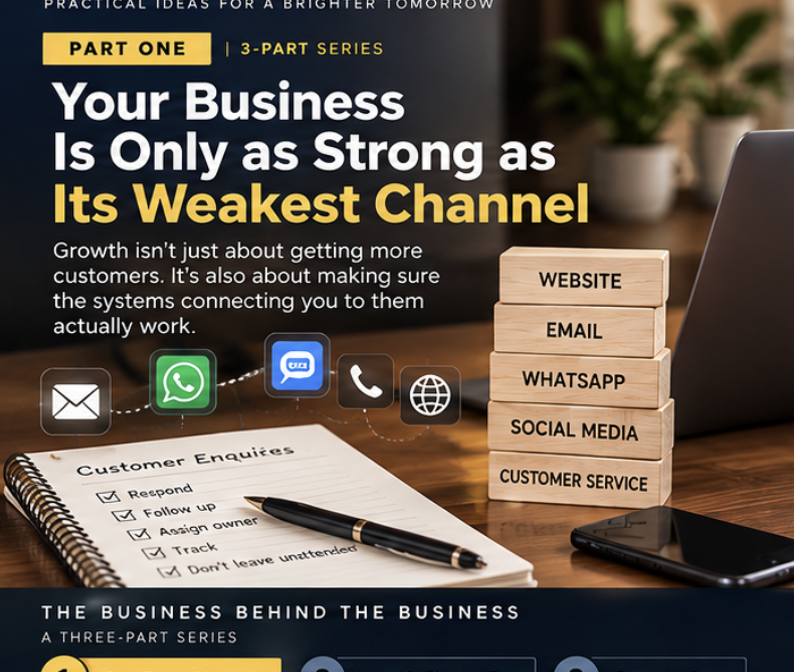
Growth isn’t just about getting more customers. It’s also about making sure the systems connecting your business to

Uncategorized
 By Admin
September 28, 2026
By Admin
September 28, 2026
Part 1: Your Business Is Only as Strong as Its Weakest Channel
By Admin
September 28, 2026
Growth isn’t just about getting more customers. It’s also about making sure the systems connecting your business to those customers actually work.
We spend a lot of time talking about how businesses grow.
More customers. More sales. More products. More branches. More distributors.
But there is another side of growth that doesn’t get nearly as much attention:
What happens to the systems behind the growth?
A business can have a great product, competitive prices and a strong sales team, yet still expose itself to unnecessary problems because one part of its customer journey isn’t working properly.
A contact form nobody checks.
A WhatsApp number nobody owns.
A payment process that isn’t clearly communicated.
A distributor network customers don’t understand.
A social-media account that looks official but isn’t actively monitored.
These may appear to be small operational issues.
They aren’t.
Every channel a business creates is a channel of trust.
And every channel of trust needs to be managed.
Own Every Channel
If you tell customers to contact you through a particular channel, someone needs to be responsible for that channel.
It sounds obvious, but it happens surprisingly often.
A customer fills in an enquiry form on a website and never gets a response.
Someone sends an email and receives nothing.
A business creates a WhatsApp number but doesn’t clearly establish who manages it.
A social-media account remains active online but nobody is monitoring the messages coming through it.
From the company’s perspective, the channel exists.
From the customer’s perspective, the business isn’t responding.
That’s an important distinction.
You cannot simply create a communication channel and consider the job done.
You have to manage it.
Because an unanswered customer isn’t just a missed sale. They may look elsewhere, complain publicly, or find another person claiming to represent your business.
And that’s where the next issue comes in.
Make Verification Easy
Businesses often assume that customers know who their authorised representatives are.
They don’t.
A customer may find a company online, contact someone through WhatsApp, receive a quotation and be asked to make payment.
Everything may look legitimate.
Until it isn’t.
The answer isn’t necessarily to make customers suspicious of everyone.
It is to make verification easy.
Who are your authorised distributors?
What are your official payment channels?
Which numbers can customers call to verify an order?
What should an authentic invoice look like?
Can a customer independently confirm that the person they’re dealing with actually represents your organisation?
The easier you make those questions to answer, the harder it becomes for someone else to exploit the gaps.
And this isn’t only about protecting customers.
It protects the brand.
Close the Gaps
Here’s the bigger lesson.
Businesses tend to design processes around what should happen.
The customer makes an enquiry.
Sales responds.
An order is placed.
Payment is made.
The product is delivered.
But real customers don’t always move through your process that neatly.
They get confused.
They ask questions.
They look for alternatives.
They contact different people.
They search online.
They find distributors.
They encounter old information.
They may even deal with someone pretending to represent you.
That’s why businesses need to look at their entire ecosystem, not just their individual departments.
Where does the customer enter?
Who responds?
Where do they get information?
Who handles smaller customers?
How do they verify a supplier?
How do they pay?
What happens when something goes wrong?
And perhaps most importantly:
Where are the gaps?
Because every gap in a legitimate process creates an opportunity for someone else to fill it.
Sometimes that person is a genuine intermediary.
Sometimes it’s a competitor.
And sometimes it’s a fraudster.
Growth Needs More Than Sales
This is something I think businesses, particularly growing businesses, need to appreciate.
You don’t just build a business by adding more customers.
You build it by strengthening the systems that support those customers.
As your business grows, your communication systems need to grow.
Your distribution systems need to grow.
Your customer service needs to grow.
Your verification processes need to grow.
Your internal accountability needs to grow.
Otherwise, you’re simply creating a bigger business with the same weaknesses.
And weaknesses that were manageable when you had 20 customers can become very expensive when you have 2,000.
The Customer Sees One Business
One of the biggest mistakes organisations make is thinking about their departments separately.
Marketing thinks about marketing.
Sales thinks about sales.
Operations thinks about operations.
Finance thinks about finance.
IT thinks about systems.
But the customer doesn’t experience your organisation as an organogram.
They experience one business.
If your website doesn’t respond, that’s your brand.
If your salesperson doesn’t explain the process, that’s your brand.
If your payment instructions are confusing, that’s your brand.
If your distributor gives the customer a completely different experience, that’s still your brand.
The customer doesn’t necessarily care which department caused the problem.
They simply know that something went wrong with the business.
That’s why the customer journey needs to be treated as one connected system.
Every Channel Is a Promise
Businesses should therefore ask themselves a simple question:
Are we managing every channel through which customers interact with us?
Not just the obvious ones.
The website.
Email.
WhatsApp.
Social media.
Sales representatives.
Distributors.
Payment channels.
Customer service.
Even the people who answer the phone.
Because every one of those touchpoints communicates something about your organisation.
And every unmanaged touchpoint creates risk.
The lesson isn’t that businesses should have fewer channels.
It’s that the channels they have should work.
Because ultimately:
Every channel is a promise. Every gap is an opportunity.
And sustainable growth isn’t just about creating more opportunities to sell.
It’s about building a business that can be trusted at every step.
Coming Next
Part 2: Who Are You Really Dealing With?
In Part Two, we look at verification, trust and the increasingly sophisticated ways in which gaps in legitimate business processes can expose both businesses and their customers to fraud.