
In business, trust is often built through very ordinary things. A company website. A branded email address. A quotation. An

Uncategorized
 By Admin
October 05, 2026
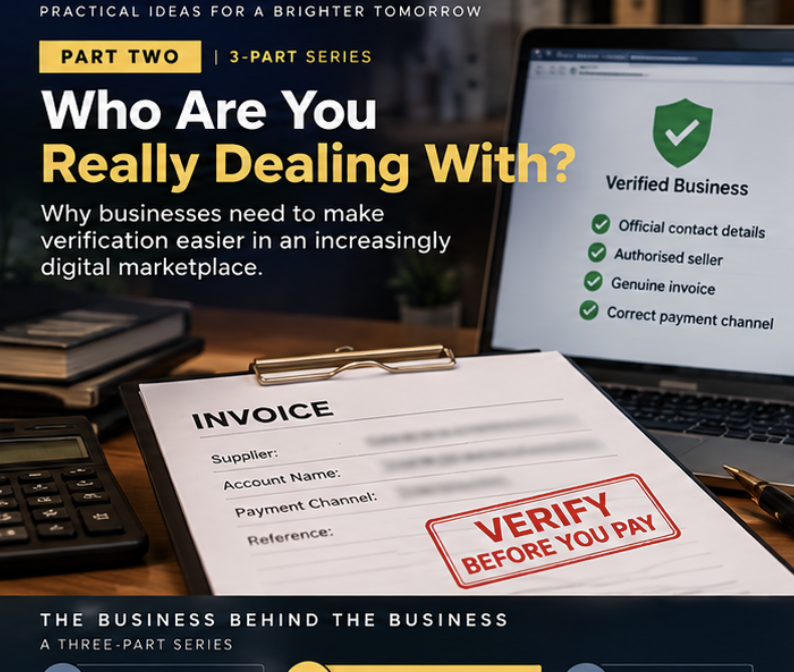
Part 2: Who Are You Really Dealing With?
By Admin
October 05, 2026
In business, trust is often built through very ordinary things.
A company website.
A branded email address.
A quotation.
An invoice.
A phone call.
A WhatsApp conversation.
A person introducing themselves as a sales representative.
None of these things, on their own, proves that the person on the other end is legitimate.
Yet we increasingly conduct business through exactly these channels.
That creates an important responsibility for businesses:
Make it easy for people to verify who they are dealing with.
This is particularly important as more business moves online.
Looking Legitimate Isn’t the Same as Being Legitimate
Imagine you are looking for a product.
You find a business online.
They have a professional-looking page. They have photographs of the products. They respond quickly to your messages. They send you a quotation.
Everything feels right.
Then they give you payment instructions.
At that point, many people make a simple assumption:
“I’ve been speaking to them, so they must be legitimate.”
But the person you’ve been speaking to and the business you think you’re dealing with may not be the same thing.
This is where verification matters.
A professional-looking interaction is not verification.
A logo is not verification.
A WhatsApp profile is not verification.
Even a quotation is not, by itself, verification.
Make Verification Part of the Customer Experience
Businesses usually think about verification from their own perspective.
They ask:
“How do we protect ourselves from fraud?”
But there is another question:
“How do we make it easy for our customers to verify us?”
That could mean clearly publishing:
- Official telephone numbers
- Official email addresses
- Authorised distributors
- Official payment channels
- Customer-service contacts
- Procedures for confirming orders
- A way to verify sales representatives
- Clear information on how genuine invoices are issued
The objective isn’t to create bureaucracy.
It is to remove uncertainty.
If a customer receives an invoice and isn’t sure whether it is genuine, they should know exactly where to go to confirm it.
If someone claims to be your distributor, customers should be able to verify that.
If you have multiple payment channels, customers should know which ones are official.
Good verification systems don’t just protect the business. They give customers confidence.
Don’t Make the Customer Guess
One of the most dangerous phrases in business is:
“They should have known.”
The customer should have known which number to call.
They should have known that this wasn’t an authorised distributor.
They should have known that the payment account was wrong.
They should have known that invoices are only sent from a particular email address.
But if you haven’t clearly communicated these things, how would they know?
Customers cannot be expected to understand your internal processes.
Your responsibility is to make the important information accessible.
The clearer the process, the less room there is for confusion.
Fraud Often Exploits Trust
Fraud doesn’t always work by creating something completely fake.
Sometimes it works by inserting a false person into a legitimate process.
A customer may genuinely want to buy something.
A genuine supplier may genuinely have the product.
A genuine delivery company may genuinely be involved.
But somewhere between those parties, another person inserts themselves into the transaction.
Suddenly, everyone believes they’re dealing with someone else.
That’s what makes some forms of fraud particularly difficult to detect.
The lesson for businesses is simple:
Don’t just secure your own transactions. Understand the points where your customers interact with third parties.
Your distributors.
Your agents.
Your delivery partners.
Your sales representatives.
Your payment providers.
Your online channels.
Every additional party introduces another point that may need to be understood and managed.
Trust Needs a Process
We often talk about trust as though it is an emotion.
“I trusted the person because they sounded genuine.”
But in business, trust should also have a process behind it.
You can trust someone and still verify.
You can have a good relationship with a supplier and still confirm their payment details.
You can know someone professionally and still follow the organisation’s procurement process.
Verification isn’t an insult.
It is good business practice.
In fact, the more money involved, the more important verification becomes.
The Five-Minute Verification
Before making a significant payment to someone you haven’t dealt with before, take a few minutes.
Don’t use the contact details they have just sent you to verify them.
Go back to an independent source.
Find the company’s official website.
Call the main number.
Ask to confirm the person.
Confirm the invoice.
Confirm the account details.
If something doesn’t match, stop.
That five-minute pause can be worth considerably more than the transaction itself.
And if the person is genuine, they should understand why you’re verifying.
Someone pressuring you to skip verification should make you more cautious, not less.
Businesses Also Need to Protect Their Name
There is another side to this.
If someone impersonates your company, it isn’t only your customers who are exposed.
Your reputation is exposed too.
Imagine a customer loses money to someone pretending to represent your organisation.
Even if you had nothing to do with the transaction, the customer’s first association may still be with your brand.
That’s why fraud prevention should not sit exclusively with finance or IT.
It should involve:
Marketing.
Communications.
Sales.
Operations.
Finance.
Customer service.
Everyone who touches the customer journey has a role to play.
Trust Is a Business Asset
A good reputation takes years to build.
But a confusing process can undermine it very quickly.
Businesses therefore need to think beyond:
“How do we sell more?”
They also need to ask:
“How do we make it easier for people to trust us safely?”
That means clear communication.
Consistent processes.
Visible accountability.
Easy verification.
And fast responses when something doesn’t look right.
Because in a digital marketplace, customers aren’t just evaluating your product.
They are evaluating whether the entire process feels trustworthy.
And that brings us to the final part of this series.
Because even when you have good people, good intentions and good systems, there can still be weaknesses where those systems meet.
Coming Next
Part Three: Where Your Business Has Gaps, Someone Else Will Fill Them
In the final part of The Business Behind the Business, we bring everything together and look at the gaps between departments, people and processes — and why sustainable growth requires businesses to strengthen the systems behind the sales.