
In the first two parts of this series, we looked at two important aspects of running a business: Own every channel. Make

Uncategorized
 By Admin
October 12, 2026
By Admin
October 12, 2026
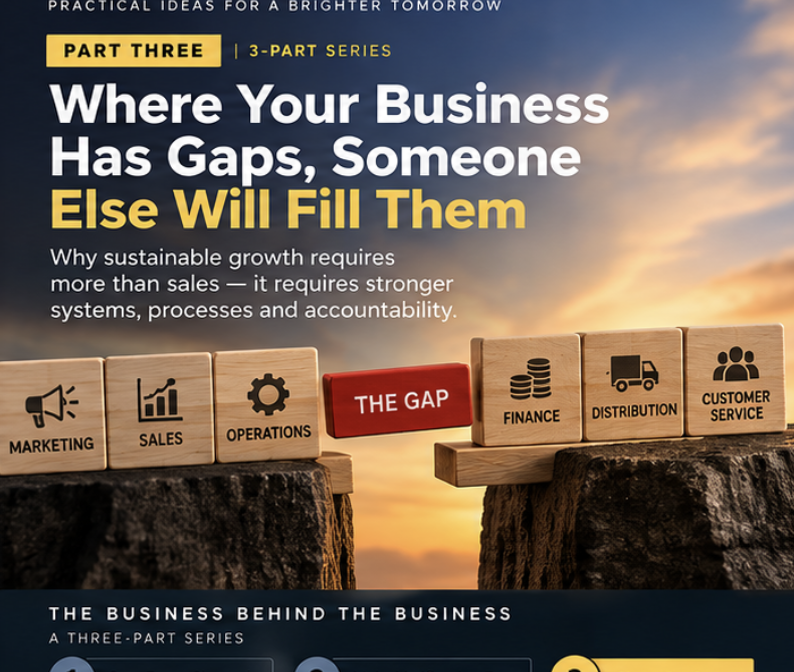
Part 3: Where Your Business Has Gaps, Someone Else Will Fill Them
By Admin
October 12, 2026
In the first two parts of this series, we looked at two important aspects of running a business:
Own every channel.
Make verification easy.
But there is a bigger issue sitting underneath both.
The gaps between your systems.
Businesses rarely fail because they have absolutely no processes.
More often, problems occur because one process doesn’t connect properly to another.
Marketing generates an enquiry.
Sales receives it.
Operations fulfils the order.
Finance processes the payment.
A third party delivers the product.
Customer service handles the complaint.
Every department may be doing its job.
But the customer can still have a terrible experience.
Why?
Because the business was looking at departments while the customer was looking at one organisation.
Your Customer Doesn’t See Your Organogram
Internally, businesses are divided into functions.
Marketing.
Sales.
Operations.
Finance.
Procurement.
IT.
Customer service.
Externally, the customer doesn’t see any of that.
They see your brand.
If the salesperson makes a promise that operations cannot deliver, the customer doesn’t blame the organogram.
They blame the business.
If finance sends confusing payment instructions, the customer doesn’t necessarily distinguish between finance and customer service.
If a distributor gives poor service, the customer still associates that experience with the manufacturer.
This is why businesses need to think about the entire customer journey, not just what happens inside individual departments.
Where Does the Process Break?
A useful exercise for any business is to take a single customer journey and follow it from beginning to end.
Imagine a customer who has never dealt with your organisation before.
They discover you.
How?
They make an enquiry.
Where does it go?
Someone responds.
How quickly?
They receive information.
Is it accurate?
They decide to buy.
How do they pay?
Their payment is confirmed.
By whom?
The order is processed.
Who knows?
The product is delivered.
Who is responsible?
They have a problem.
Who do they contact?
At every stage, there should be an answer.
And if there isn’t one, you’ve found a gap.
Every Gap Has a Cost
Some gaps cost money.
Others cost time.
Others cost customers.
And some can create serious reputational or security risks.
An unanswered enquiry can mean a lost sale.
A poorly communicated price can create conflict.
An unclear payment process can expose customers to fraud.
A distributor who isn’t properly managed can damage the customer experience.
A lack of accountability can allow small problems to become major ones.
The important thing is that most of these problems are visible before they become crises.
You simply have to look for them.
Growth Magnifies Weaknesses
When a business is small, the founder often holds everything together.
They know the customers.
They know the suppliers.
They know where the products come from.
They know who to call.
They know how payments are made.
They know what happens when something goes wrong.
Then the business grows.
More employees join.
More suppliers are introduced.
More customers arrive.
More products are added.
More distributors become involved.
Suddenly, the knowledge that used to sit in one person’s head needs to become a system.
This is one of the most important transitions in business growth:
Moving from people-dependent operations to process-supported operations.
The goal isn’t to remove people.
It is to make sure that the business doesn’t stop working simply because one person isn’t available.
Build the Business Behind the Business
A successful business has two layers.
There is the business customers see:
The product.
The service.
The brand.
The sales.
The marketing.
Then there is the business behind it:
The processes.
The systems.
The controls.
The communication channels.
The people responsible.
The information flows.
The verification mechanisms.
The financial controls.
The supplier relationships.
The escalation procedures.
The second layer may not be visible to customers, but it determines how consistently the first layer works.
And as a business grows, that second layer becomes increasingly important.
Don’t Just Add More Sales
Growth is often measured in numbers.
Revenue increased.
Customers increased.
Orders increased.
Branches increased.
But there is another question worth asking:
Did the organisation become stronger as it grew?
If revenue doubles but customer complaints triple, something is wrong.
If orders increase but fulfilment becomes chaotic, something is wrong.
If the business acquires more customers but relies on the same informal processes it had when it was much smaller, something is wrong.
Growth should create a stronger organisation, not simply a larger one.
A Simple Test
Every few months, businesses should step back and ask:
What are our most important customer touchpoints?
Who owns each one?
Where can customers become confused?
Where could someone impersonate us or exploit a gap?
Which processes depend too heavily on one person?
Where are we relying on assumptions instead of documented information?
What happens when something goes wrong?
These aren’t complicated questions.
But they can reveal problems that aren’t obvious when everyone is busy doing their day-to-day jobs.
The Three Lessons
Looking across this three-part series, the message is quite simple.
First: Own Every Channel.
If you create a channel for customers, take responsibility for it.
Second: Make Verification Easy.
Don’t expect customers to guess what is genuine. Give them a clear way to verify the people, processes and payment channels they are dealing with.
Third: Close the Gaps.
Look beyond individual departments and understand how the entire customer journey works.
Because somewhere between your website, sales team, distributor, finance department, delivery partner and customer service team, there may be a gap.
And if you don’t close it, someone else may eventually fill it.
The Business Behind the Business
The strongest businesses aren’t necessarily those with the most complicated systems.
They are often the ones where people understand how the pieces fit together.
They know who is responsible.
They know how information moves.
They know how customers are supported.
They know how payments are verified.
They know how problems are escalated.
And they regularly ask:
“Where could this process fail?”
That question is important because businesses don’t become resilient by assuming everything will go according to plan.
They become resilient by understanding what happens when it doesn’t.
Growth is good.
More customers are good.
More sales are good.
But sustainable growth requires something else:
A business behind the business that is strong enough to support it.
And perhaps the simplest way to remember the entire series is this:
Every channel is a promise. Every gap is an opportunity. Every growing business needs systems strong enough to protect both.